
What Kind of Content to Create for B2B Content Marketing
TL;DR:
- B2B content types are organized around the funnel: TOFU, MOFU, and BOFU
- TOFU: blog posts, original research, infographics, LinkedIn content, podcasts and video
- MOFU: case studies, webinars, email newsletters, comparison guides, product-led tutorials
- BOFU: pricing pages, FAQs, testimonials, ROI calculators, free trials and demo content
- Most B2B content programs are heavy on TOFU and light on everything else
- Audit your current mix, find the gap, and fill that before adding more of what you already have
You could have a content calendar full of blog posts, a webinar on the books, and a newsletter going out every two weeks. And still have a pipeline problem.
The issue usually isn’t output. It’s that the content is doing one job repeatedly while the buyer needs something completely different to take the next step. A blog post that explains why a problem exists won’t close a buyer who already knows the problem exists and is now comparing your solution to three competitors.
This guide covers what kind of content to create for B2B content marketing at each stage of the buyer journey, how to choose what to prioritize, and the execution principles that make any format actually perform.
Why Content Type Matters in B2B Marketing
B2B buying is not a single moment. It’s a process. According to Demand Gen Report’s B2B Content Preferences Survey, 62% of B2B buyers engage with three to seven pieces of content before they’ll agree to speak with a salesperson. And those pieces of content aren’t doing the same thing. They’re doing different things at different points in a buyer’s evaluation.
That’s the core reason content type matters. A comparison guide serves a buyer who is already solution-aware and evaluating options. An educational blog post serves a buyer who is just becoming problem-aware. Publishing only one of these formats and expecting it to carry the full buyer journey is how B2B content programs end up generating traffic with no pipeline to show for it.
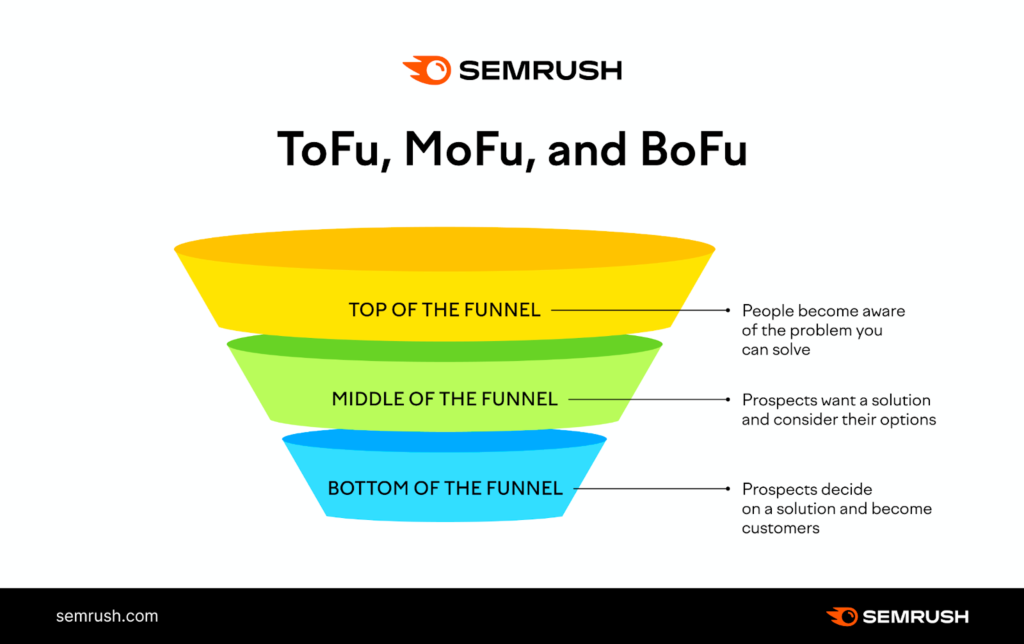
The most practical way to approach B2B content types is through the marketing funnel:
- Top of funnel (TOFU) for awareness
- Middle of funnel (MOFU) for consideration
- Bottom of funnel (BOFU) for decision
Each stage has content types that fit the buyer’s mindset at that moment.
Top-of-Funnel B2B Content Types (Awareness)
TOFU content is for buyers who don’t know you yet, or who know they have a problem but haven’t started evaluating solutions. The job here is to show up where they’re looking, demonstrate that you understand their world, and give them a reason to pay attention.
Blog Posts and Long-Form Articles
Blog posts are the foundation of most B2B content marketing strategies. Well-researched, search-optimized articles build organic traffic over time and compound in value the longer they’re live.
The difference between B2B blog content that performs and content that doesn’t is usually specificity. Generic posts that skim the surface of a topic don’t build credibility with buyers who already know the basics. The posts that rank and convert tend to go deep on a focused angle, answer a question the buyer is actively searching for, and leave them with something concrete they can apply.
Original Research and Industry Reports
Original research is one of the highest-leverage content investments in B2B. A focused survey or data study gives you something competitors can’t copy: proprietary findings. It earns backlinks naturally, gets cited in other publications, and positions your brand as a credible voice in the category.
The bar doesn’t have to be a 50-page annual report. A well-designed study of 200 to 500 respondents on a specific topic your audience cares about can generate real SEO value and awareness. The 2024 Edelman-LinkedIn B2B Thought Leadership Impact Report found that 73% of B2B decision-makers say research-backed content is a more trustworthy basis for evaluating a company’s capabilities than its marketing materials. Data earns trust in a way that brand messaging can’t.
Infographics and Data Visualizations
Infographics work in B2B when they distill complex data or multi-step processes into something a busy reader can absorb quickly. They perform well on LinkedIn and in industry newsletters, and they pick up shares in a way most written content doesn’t.
They work best as companions to longer articles, not standalone pieces. The infographic gets shared; the article does the explaining.
LinkedIn Content
For B2B, LinkedIn is the social channel that matters most. It’s where buyers follow industry conversations, evaluate the people behind a brand, and increasingly research vendors before they ever visit a company website.
The LinkedIn content that builds awareness in B2B includes specific observations from real work, direct commentary on industry trends, and posts that teach the reader something they can use immediately. Content that reads like it came from a real person with a genuine perspective consistently outperforms polished brand copy on the platform.
Podcast Episodes and Video Content
Audio and video are growing in B2B, particularly for audiences who consume content between meetings or during commutes. Podcasts work well for brand building and reaching buyers who wouldn’t find you through search alone.
Video content, specifically educational clips and product walkthroughs, performs well on LinkedIn and YouTube. Semrush’s State of Content Marketing research found that articles with at least one embedded video generate 70% more organic traffic than those without. If you’re producing video, embedding it in your written content is a practical way to extend its reach.
Middle-of-Funnel B2B Content Types (Consideration)
MOFU buyers know their problem and are actively evaluating solutions. They’re comparing options, reading reviews, and trying to figure out whether your approach fits their situation. The job here is to build credibility and give the buyer the information they need to move closer to a decision.
Case Studies
Case studies are one of the most effective B2B content formats at the consideration stage. A well-written case study shows that you’ve solved a problem similar to the buyer’s, explains how you did it, and provides evidence that the results were real.
The case studies that actually influence decisions tend to be specific. They name the client or describe their profile clearly, they explain the situation before your involvement, and they include measurable outcomes. “We helped a SaaS company increase traffic” is not a case study. “We helped a Series A HR tech startup increase organic leads by 43% in six months by rebuilding their content architecture” is.
Webinars and Virtual Events
Webinars give B2B buyers a chance to evaluate your expertise in real time. They’re particularly effective for complex products or services where the buyer needs to understand how something works before committing to a conversation.
The formats that perform best in B2B webinars are specific and practical: tutorials, expert panels on a defined topic, and live Q&A sessions tied to a real problem your audience is working through. Broad “state of the industry” webinars tend to get lower attendance and lower conversion after the fact.
Email Newsletters
Email is one of the most underrated channels in B2B content marketing. A newsletter with a consistent point of view and a clear focus on a specific topic builds a direct relationship with your audience that no algorithm can disrupt or deprioritize.
The newsletters that build real loyalty in B2B tend to be opinionated. They don’t just curate links. They offer analysis, take a position, or share something the reader genuinely couldn’t find elsewhere.
Comparison Guides and “Versus” Content
Buyers in the consideration stage are comparing you to alternatives. They’re searching for “[your category] alternatives,” “[your product] vs [competitor],” and “best [solution] for [their use case].” If you’re not showing up for those searches and addressing those questions directly, you’re leaving the evaluation stage entirely to your competitors.
Comparison content doesn’t need to dismiss alternatives. It needs to be honest and specific. The goal is to help the buyer make a well-informed decision. That honesty builds more trust than a one-sided comparison that reads like a product page.
Product-Led Content and Tutorials
Product-led content teaches the reader how to solve a specific problem using your product as part of the solution. It’s particularly effective in B2B SaaS, where buyers often want to understand how a tool actually works before they’ll consider a trial or demo.
A tutorial that walks through a specific workflow using your product gives the buyer a preview of the experience and reduces the perceived risk of trying it. It also tends to attract high-intent readers who are already in evaluation mode, making it one of the higher-converting formats in a B2B content strategy.
Bottom-of-Funnel B2B Content Types (Decision)
BOFU buyers have done their research and are close to a decision. The content job at this stage is to remove the friction standing between them and a commitment.
Pricing Pages and FAQs
Buyers check your pricing page before they talk to sales. Most B2B companies treat it as a transactional afterthought when it’s actually a content opportunity. A pricing page that explains your tiers clearly, addresses common objections, and helps the buyer self-select the right plan does significant sales work before any conversation happens.
FAQs tied to pricing, implementation, and onboarding serve the same function. They answer the questions buyers are too hesitant to raise in a sales call, and they reduce the time your team spends repeating the same explanations.
Customer Testimonials and Reviews
Social proof matters most at the bottom of the funnel. Buyers want confirmation that the decision they’re leaning toward is one other people in similar situations have made successfully.
Effective B2B testimonials are specific and role-relevant. A generic quote from an unnamed company carries almost no weight. A quote from a Head of Marketing at a 50-person SaaS company explaining exactly what problem your service solved, and what changed afterward, is a different level of credibility entirely.
Maintaining an active presence on review platforms in your category is also worth the investment. According to the 2025 G2 Buyer Behavior Report, software review sites are now the second most influential source in B2B vendor shortlisting, ranking just behind AI chatbots and ahead of vendor websites and analyst firms.
ROI Calculators and Interactive Tools
Interactive tools give buyers a way to quantify the value of your solution in their specific context. An ROI calculator that takes their current situation as input and outputs a projected outcome is more persuasive than any claim you could make in a sales deck.
These tools require more investment than most content formats, but they perform well at the bottom of the funnel because they make the value concrete and personal rather than theoretical.
Free Trials and Demo Content
For B2B SaaS specifically, free trials and product demos are content in their own right. A well-structured free trial with in-product guidance removes the final barrier between consideration and commitment.
Pre-recorded demo content and interactive product tours serve buyers who want to see the product before they’re ready to talk to sales. Publishing this content openly rather than gating it behind a form reduces friction and improves the quality of leads who do eventually request a live conversation.
How to Choose the Right B2B Content Type for Your Business
Knowing what content types exist is useful. Knowing which to prioritize for your specific situation is what actually moves things. Four questions to answer before you commit to a format:
What stage of the buyer journey are you trying to support? If your pipeline is thin, TOFU content deserves the most investment. If you’re generating awareness but losing buyers during evaluation, MOFU content needs attention. If your sales cycle stalls before closing, BOFU content that removes friction is where to focus.
Who is your buyer and where do they spend time? A VP of Engineering at a Series B startup reads different things and uses different platforms than a Marketing Director at a mid-market enterprise. The right B2B content type is partly determined by where your specific buyer will actually encounter it.
What resources do you realistically have? Original research and video produce strong results but require real investment. A two-person marketing team is better served by a tight calendar of well-researched blog posts and one solid case study per quarter than by an ambitious multi-format program that stretches the team too thin.
What does your current content mix look like? Most B2B content programs have gaps. A quick audit against the funnel stages usually reveals plenty of TOFU content and almost nothing in MOFU or BOFU. The easiest wins come from filling the most obvious gap, not adding more of what you already have.
B2B Content Marketing Tips to Make Any Format Perform
The content type you choose matters. How you execute it matters more.
- Prioritize depth over volume. One well-researched, genuinely useful piece of content outperforms five shallow ones in B2B. Buyers are sophisticated. They can tell the difference between content written to fill a calendar and content written to actually help them.
- Use real data and specific examples. Vague claims don’t build credibility in B2B. When you make a point, support it with a specific example, a verified data point, or a concrete outcome from your own experience. This is what separates content that reads like marketing from content that reads like expertise.
- Optimize for search and distribution. Even the best B2B content delivers limited value if no one finds it. Every piece should have a clear primary keyword, a distribution plan, and a realistic path to the audience it’s meant to reach. For blog content, that means proper heading structure, internal linking, and on-page SEO fundamentals. For LinkedIn, it means publishing consistently and engaging with comments to extend organic reach.
- Repurpose strategically. A single well-performing piece of B2B content can fuel multiple formats. A research report becomes a series of LinkedIn posts, a webinar topic, and a blog article. A case study becomes a testimonial quote, a cold email reference, and a sales deck slide. Building repurposing into your content workflow multiplies the return on every piece you create.
What Will You Create First?
The question of what kind of content to create for B2B content marketing has a clear answer once you know what stage of the buyer journey you’re trying to support. Map your content to the funnel. Find where your program has gaps. Fill those gaps before adding more of what you already have.
If you’re building or rebuilding a B2B content strategy and want a system that connects content to actual pipeline, get in touch. That’s the problem I help B2B SaaS teams solve.